










Curacao non gamstop casinos display a Gaming Control Board permit seal
Offshore operators holding a Gaming Control Board permit fall outside the British regulatory framework and therefore never connect to the domestic exclusion database.
Under the Gambling Act 2005, providing betting facilities to British residents without a local operating permit is a statutory offence, and a foreign certificate does not grant legal access to this market. Because curacao casinos accepting uk players operate without domestic oversight, they are not bound by the licensing condition effective from 31 March 2020 that mandates participation in the national self-exclusion scheme.
When comparing wider non-gamstop casinos, verifying the regulatory seal in the website footer clarifies which offshore authority oversees the corporate entity.
Curacao regulators never enforce domestic GamStop self-exclusion blocks
The National Online Self Exclusion Scheme Limited only enforces account restrictions across companies licensed in Great Britain.
Consequently, curacao casinos not on gamstop cannot query the domestic register where users select exclusion terms of six months, one year, or five years. Any self-exclusion request at curacao casinos not regulated by gamstop must be submitted directly to the individual operator's support desk rather than through a central national portal.
Authentic Curacao licences on non-GamStop sites display a clickable GCB seal
A genuine Gaming Control Board digital seal links directly to an encrypted validator page displaying the active permit status and approved domain URL.
| Verification Step | Genuine Curacao GCB Seal | Fake or Expired Licence Badge | How to Confirm |
|---|---|---|---|
| Certificate URL domain | Redirects to the official cert.gcb.cw regulator subdomain | Links to a self-hosted page or refreshes the casino homepage | Inspect the browser address bar and SSL security certificate |
| Domain name match | Exact match between the active casino URL and the certificate record | Displays a different brand domain or omits the URL field | Compare the active web address with the text on the validator |
| Licence status indicator | Marked as active or valid under current GCB transitional rules | Shows suspended, revoked, or displays an outdated sub-licence code | Read the status banner at the top of the digital seal |
| Corporate registration number | Lists a verifiable Curacao Chamber of Commerce company number | Leaves the company name blank or uses an unregistered shell title | Cross-check the company number against the terms and conditions |
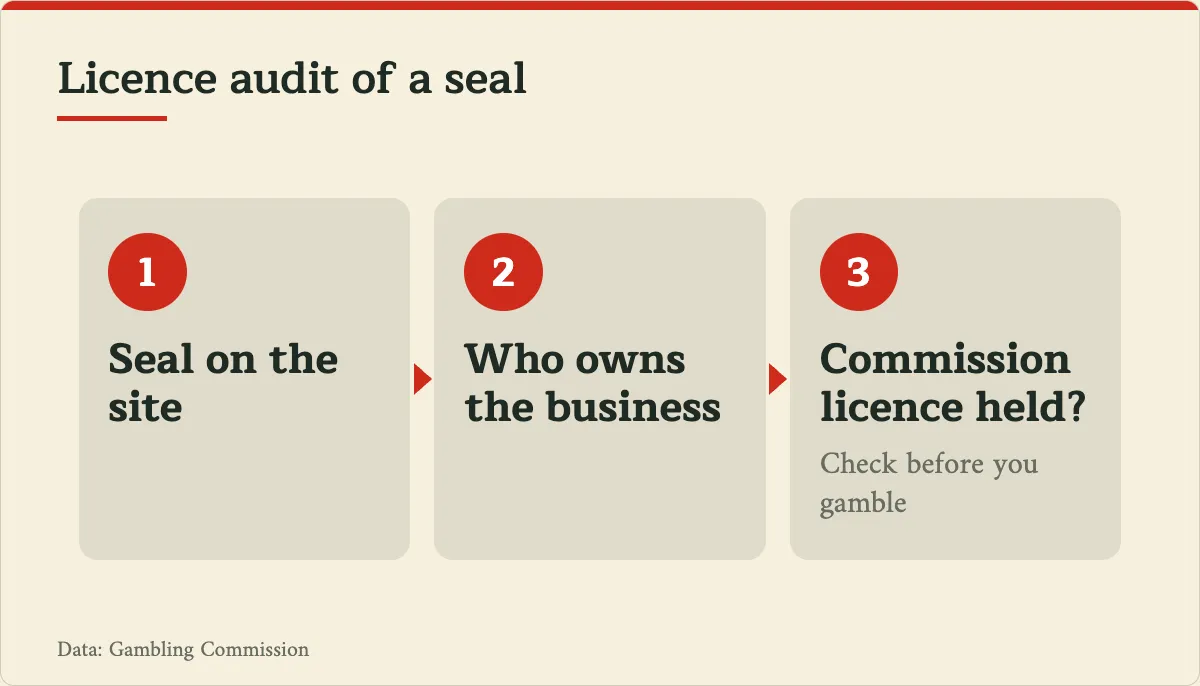
Anyone running an instaspin casino license check or auditing another offshore platform must click the footer emblem to confirm it opens the official regulator portal rather than a static image. The UK Gambling Commission warns that unlicensed sites frequently block withdrawals or set unattainable payout thresholds while exposing personal data to fraud. Inspecting the digital certificate confirms whether the platform qualifies as a reputable non gamstop casino with verifiable corporate backing.
Comparing the live certificate parameters against the active browser address bar takes less than a minute and exposes cloned websites immediately.
Static footer images without a cert.gcb.cw verification link indicate an unlicensed site
Fraudulent gambling portals routinely paste unlinked PNG logos at the bottom of their homepage to mimic regulatory oversight.
If clicking the emblem produces no redirect to the cert.gcb.cw domain, the operator lacks a valid digital seal and players have zero protection against confiscated balances.
Direct GCB licensing in Curacao replaced the old master sub-licence structure
Regulatory reform in Curacao abolished the historic system where four private master permit holders issued commercial sub-licences without direct state vetting.
- Direct state oversight replaces private sub-licensing by commercial master holders.
- Mandatory corporate disclosure requires identifying all ultimate beneficial owners.
- Updated compliance rules enforce stricter anti-money laundering and player dispute protocols.
- Official digital seals on cert.gcb.cw replace legacy third-party validator scripts.
Every offshore gaming company in the jurisdiction must now apply directly to the Gaming Control Board and pass stricter corporate ownership, financial solvency, and compliance audits. Previously, master licence holders rarely intervened in player payout disputes, leaving customers of curacao casinos not signed up to gamstop without an effective escalation channel.
Before depositing, verify that the footer certificate reflects a direct GCB permit or an active transitional registration rather than a defunct sub-licence string.
Corporate registry checks confirm who owns curacao non gamstop casinos
Cross-referencing the company registration number in the casino terms against the Curacao Chamber of Commerce database confirms the legal entity behind the website.
Authentic curacao non gamstop casinos publish both their parent company name and their statutory registration number in the footer and user agreement. If a site hides its corporate identity or lists a dissolved entity, the UK Gambling Commission notes that consumers face severe data protection risks and have no legal recourse when disputes arise.
Executing this registry audit is especially important when evaluating new non gamstop casinos that have no established payout history.
European payment subsidiaries process card transactions for offshore Curacao operators
Curacao parent companies frequently establish wholly owned billing subsidiaries in European jurisdictions such as Cyprus to access international banking networks.
While the UK Gambling Commission prohibits domestic operators from accepting credit card deposits for gambling, offshore platforms operate outside British banking mandates and rely on external payment agents. Matching the Cyprus billing agent named in the casino terms with the corporate ownership group prevents unexpected bank statement descriptors and clarifies who handles fiat transfers.
Understanding how offshore merchants route card settlements helps players evaluate the safest payment methods non gamstop casinos support before sharing financial credentials.
Cyprus billing agents handle Visa and Mastercard settlements for Curacao sites
Acquiring banks require a locally registered corporate presence to clear Visa and Mastercard payments for offshore gaming brands.
Legitimate operators explicitly name their Cyprus or European processing subsidiary inside the terms and conditions so cardholders can verify that the billing agent belongs to the licensed parent group.
Escalating a payout dispute at a Curacao casino requires internal review first
Withheld withdrawals at a Curacao-licensed platform must first go through the operator's internal complaints procedure before any external body will review the case.
- Submit a formal written complaint to the operator's designated compliance email address.
- Attach unedited screenshots of account balances, bonus terms, and identity verification approvals.
- Retain all timestamped email replies until the internal resolution window expires.
- Verify whether the active GCB certificate lists an external dispute resolution mechanism.
In the regulated British market, the UK Gambling Commission requires players to complain to the business first and wait up to 8 weeks before escalating unresolved financial claims to a free Alternative Dispute Resolution provider, which excludes general customer service issues. The Commission also provides a confidential portal to report suspected illegal gambling, though that form never resolves individual payout complaints. For offshore sites, players must save all chat transcripts and transaction hashes to prove they exhausted internal channels.
Checking recent player reports in discussions non gamstop casinos host can reveal whether a specific operator resolves formal payout complaints or ignores regulator inquiries.
Player protection rules at Curacao casinos outside GamStop differ from domestic law
Customers using offshore Curacao platforms do not receive the statutory consumer protections, fund segregation guarantees, or mandatory limit tools enforced in Great Britain.
The UK Gambling Commission states that only locally licensed businesses fall under British consumer protection rules, whereas unlicensed sites frequently lack robust age verification and responsible gambling controls. Under the domestic GAMSTOP scheme, removing an exclusion after the minimum term requires contacting the helpdesk and waiting through a 24-hour cooling-off period, followed by a seven-year post-exclusion monitoring phase; Curacao sites apply neither rule. Furthermore, while the HMRC Business Income Manual notes that consumer betting does not constitute trading and customer winnings remain at 0 tax-free under British rules, offshore players bear full personal responsibility for verifying account terms.
Anyone needing free support with gambling control can contact the National Gambling Helpline (run by GamCare) on 0808 8020 133 at any time, or self-refer to the National Problem Gambling Clinic in England.
Curacao AML regulations mandate identity checks on offshore fiat and crypto payouts
Anti-money laundering statutes in Curacao compel licensed operators to verify player identity and residential address before releasing fiat or cryptocurrency withdrawals.
Marketing claims that offshore platforms permit completely anonymous cashouts contradict Gaming Control Board compliance rules, which require Know Your Customer documentation to prevent illicit financial flows. Operators routinely accept initial deposits without friction but freeze outbound transfers until a valid passport, government ID, and utility bill are uploaded and approved.
Submitting verification documents immediately after account creation prevents multi-day payout delays when requesting a first withdrawal.
Source-of-wealth checks trigger when Curacao payouts cross AML thresholds
Cumulative deposits or large withdrawal requests that cross statutory anti-money laundering thresholds trigger mandatory source-of-wealth audits.
Compliance departments will hold the pending balance until the account holder provides bank statements, payslips, or crypto wallet histories proving the legitimate origin of the staked funds.