










This FAQ non gamstop casinos guide explains ID uploads and cashier limits
Our faq non gamstop casinos directory addresses document rejection triggers, saved card removal conditions, and statutory GamStop rules. Operators licensed by the Gambling Commission must display their licence status clearly on their platforms, whereas offshore sites operate outside this British framework.
- GamStop registration terms and manual deactivation procedures after initial periods expire.
- Identity document corner visibility requirements and utility bill formatting for compliance teams.
- Cashier conditions for unlinking expired debit cards when no withdrawals are pending.
- Dormant account balance deductions and household IP address duplication locks.
Unlicensed platforms often set unattainable withdrawal limits or block payouts entirely while posing severe identity theft risks. Before uploading personal files or comparing non-gamstop casinos, players should verify how an operator handles payment data and dispute escalation.
GamStop self-exclusion rules keep blocks active until you request manual removal
The National Online Self Exclusion Scheme Limited keeps every GamStop block active indefinitely until the registered user requests manual removal after the selected period ends. This FAQ rule applies across participating British operators for initial terms of six months, one year, five years, or five years with auto renewal.
| GamStop Rule Question | Official Scheme Condition | Expiry & Renewal Mechanism | Deactivation Requirement |
|---|---|---|---|
| Six-month restriction | Blocks online accounts in Great Britain for six months | Does not end automatically when the six months finish | Contact Centre request plus a 24 hours cooling-off wait |
| One-year restriction | Blocks participating British online accounts for one year | Remains active indefinitely after one year without user action | Manual removal via Contact Centre after a 24 hours wait |
| Five-year standard restriction | Applies the longest standard five years term in Great Britain | Stays active past five years until the user intervenes | Direct Contact Centre request and a 24 hours delay |
| Five-year auto-renewal option | Sets a recurring five years block on participating British sites | Begins another five-year period automatically when the current term ends | Requires contacting GamStop before renewal plus a 24 hours wait |
| Post-removal seven-year notice | Applies after an active GamStop block is officially removed | Informs operators of past registration during a seven-year period | Operates automatically under scheme rules after removal completes |
Contacting GamStop is the only way to end a five-year auto-renewal exclusion
Selecting the five-year auto-renewal option causes another five-year restriction period to begin automatically as soon as the current term ends. Users must contact the GamStop Contact Centre to stop this recurring cycle, and the system enforces a 24 hours cooling-off wait before access resumes.
Deactivation answers explain how GamStop notifies operators for seven further years
Once a self-exclusion is officially removed, GamStop notifies gambling operators about the user's previous registration for a further seven-year post-self-exclusion period. This rule applies across all online gambling companies licensed in Great Britain that check the national database.
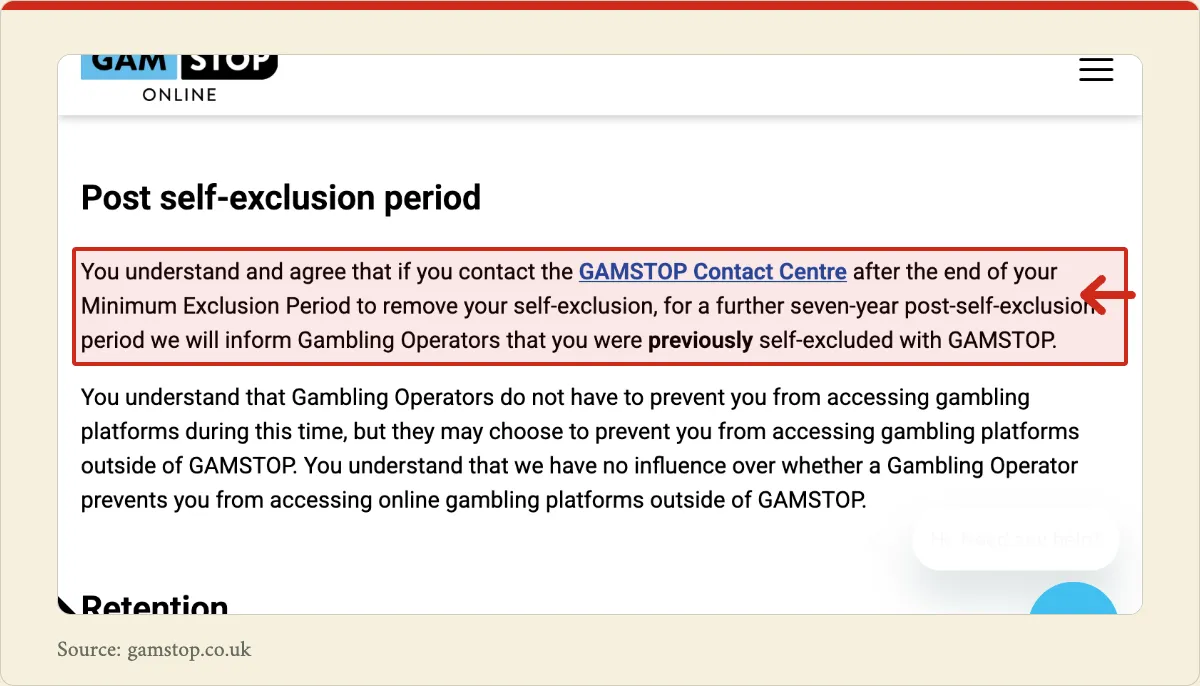
Domestic operators use this seven-year notification marker to apply internal safer gambling checks and monitor returning customer activity. Platforms outside GamStop do not connect to this British register, meaning neither active blocks nor seven-year historical notices appear on offshore sites.
KYC questions in our offshore casino guide cover cropped photo rejections
Offshore compliance departments reject identity and address files primarily when camera glare obscures text or cropped edges hide document borders. The Gambling Commission warns that unlicensed sites carry serious data protection concerns, exposing players to identity theft and fraud risks when submitting sensitive records.
Unlike platforms governed by British consumer protection rules, offshore operators set their own internal file verification standards before approving withdrawals. Checking how a reputable non gamstop casino encrypts uploaded files helps reduce data exposure during manual account reviews.
Compliance teams require all four document corners visible without digital edits
Verification reviewers decline passport scans and utility bills whenever a single corner falls outside the camera frame or software alters the image metadata. Submitting an unedited colour photograph showing all four corners on a flat surface prevents repeated KYC rejection loops.
Before uploading high-resolution identity files to an offshore cashier, players should verify the operator's privacy policy and storage security.
Cashier rules require zero pending payouts before removing a saved payment card
Online account rules require zero pending requests before removing saved details from an active profile on non-GamStop platforms. Under the Gambling Commission credit card prohibition, domestic operators must reject credit card payments, while checking the payment methods non gamstop casinos list clarifies how offshore cashier systems handle payouts and saved card removal.
Support agents unlink expired debit cards after verifying a replacement payout account
Support agents unlink expired credentials only after verifying a replacement account through uploaded ownership documents. Because unlicensed sites often lack dispute resolution schemes, users on offshore platforms should confirm that all pending requests have completed before asking staff to purge old records.
Dormant account clauses in our FAQ non gamstop casinos explain inactivity fees
Offshore terms and conditions allow operators to deduct monthly administrative fees from real-money balances when an account remains logged out for consecutive months. While the Gambling Commission states that customer gambling winnings are 0 tax-free in Great Britain regardless of the amount won, private operator dormancy charges still erode idle funds.
Consulting this faq non gamstop casinos checklist reminds players to withdraw all cleared balances before taking a break from an offshore site. Once an account balance reaches zero, contractual inactivity deductions stop accumulating.
Shared household Wi-Fi and masked IP addresses trigger duplicate account locks
Automated security filters freeze casino profiles immediately when two accounts log in from the same household router or a connection routes through a proxy server. Under the Gambling Act 2005, a licence issued in another country does not permit an operator to provide gambling facilities in Great Britain.
When an offshore operator locks an account over shared Wi-Fi or IP masking flags, British consumers face a lack of formal recourse if things go wrong. Most terms restrict promotional offers and account registration to one profile per physical household address and shared internet connection.
Regulatory answers explain how consumers confidentially report suspected illegal sites
The Gambling Commission operates a confidential reporting service for suspected illegal gambling websites, though this intelligence form does not process individual player complaints. Section 33 of the Gambling Act 2005 makes it an offence to provide gambling facilities to British consumers without a Commission operating licence.
At licensed sites, players must complain to the operator first and wait eight weeks before referring unresolved financial disputes to an Alternative Dispute Resolution provider, which excludes customer service issues. Anyone needing confidential support can call the National Gambling Helpline (run by GamCare) on 0808 8020 133 free at any hour, or self-refer to the National Problem Gambling Clinic in England.